


Farm Borehole Drilling – What Size Borehole Does a Farm Need?
Need to install a borehole on your farm? Call Tomahawk today.
A farm borehole should be planned around the amount of water the property actually needs. Livestock, crop irrigation, staff facilities, washing, spraying and general farm operations can place very different demands on a groundwater supply. That’s why there isn’t a standard borehole size that suits every farm.
Professional farm borehole drilling starts by looking at the intended water use, potential groundwater, required daily volume and the ability to store water between periods of high demand. Borehole depth is important, but depth alone doesn’t determine whether a borehole is suitable for agricultural use.
Tomahawk Borehole Drilling provides farm borehole drilling, groundwater surveys, yield testing and complete pump installations for agricultural properties in Gauteng and the Vaal Triangle.
What Size Borehole Does a Farm Need?
When farmers ask about borehole size, they may be referring to borehole depth, diameter, pump capacity or the amount of water the borehole can supply.
For most agricultural applications, borehole yield is far more important than simply drilling deeper.
A deep borehole with a low sustainable yield may supply less usable water than a shallower borehole that intersects a productive water-bearing fracture.

The right farm borehole system therefore depends on questions such as:
- How many litres of water does the farm use each day?
- Will the borehole supply livestock?
- Is the water required for crop irrigation?
- How many hectares need water?
- Will there be storage tanks or reservoirs?
- How quickly does the borehole recover after pumping?
- How far must water be pumped?
- What pressure is required?
- Will the borehole be the primary or supplementary water source?
These factors determine how the borehole should be equipped after drilling.
Farm Borehole Drilling Starts With Water Demand
Before specifying pumps, tanks or irrigation equipment, it helps to calculate what the farm actually needs from the borehole.
A livestock operation may need relatively steady water throughout the day. Irrigation can create much higher demand over shorter periods. A mixed farm may need water for livestock, crops, cleaning, staff housing and general use.
Peak demand also deserves attention. A farm might consume a certain total volume over 24 hours, but that doesn’t mean the borehole must deliver the full daily requirement immediately. Water can often be pumped gradually into storage and used later when demand increases.
This is why farm borehole design should consider the complete water system rather than the drilled hole alone.
Groundwater Surveys for Agricultural Boreholes
Choosing where to drill is an important first step. Groundwater isn’t evenly distributed beneath a farm. In many areas, productive boreholes depend on intersecting fractures, weathered geological structures or other formations that can store and transmit groundwater.
A groundwater survey can help identify promising drilling positions before the rig starts working.
For larger farms, this is particularly useful because several possible drilling areas may be available. The final position should consider groundwater potential as well as vehicle access, electrical supply, distance from tanks and the area where the water will ultimately be used.
Tomahawk can assist with geological surveying, borehole siting and the drilling process as part of one agricultural borehole project.
Borehole Yield Is Critical for Farms
Finding groundwater doesn’t automatically mean the borehole can meet agricultural demand. The important figure is the sustainable borehole yield. Yield refers to how much water can be abstracted while allowing the borehole to recover appropriately. This is usually expressed as a flow rate, such as litres per hour.
A farm with modest livestock requirements may be able to operate successfully with a lower-yield borehole combined with sufficient storage. Large irrigation requirements can demand considerably more water.
After drilling, Tomahawk provides borehole yield testing so that pump selection and water planning can be based on the borehole’s actual performance rather than assumptions.
You can read more about the drilling and testing stages on Tomahawk’s borehole drilling process page.
Farm Boreholes for Livestock Water
Livestock water requirements depend on animal type, numbers, weather conditions, feed, production systems and access to other water sources.
The borehole installation needs to keep drinking troughs or storage points supplied without drawing from the borehole faster than it can recover. Storage tanks can be particularly useful on livestock farms. The borehole can pump steadily into storage, while animals draw water from the stored supply as needed. This reduces the need for the borehole to match short periods of heavy consumption directly.
Pump controls, tank level systems and appropriately sized pipelines can also help automate the water supply across the farm.
Borehole Drilling for Farm Irrigation
Irrigation changes the calculation significantly because crop water demand can be substantial.
A farmer considering a new agricultural borehole should establish how much land will be irrigated, which crops are involved, the irrigation method and how frequently irrigation will take place.
The borehole’s available yield then needs to be compared with that demand. If the borehole can’t provide the full irrigation volume during the irrigation cycle, water storage may form part of the solution. Water can be accumulated over a longer period and released when the irrigation system operates.
This is often more practical than selecting an oversized pump that attempts to draw water faster than the borehole can sustainably provide.

Our Turnkey borehole drilling services include:
Dowsing
Geological Survey
Geotechnical Drilling
Water Borehole Drilling
Borehole Maintenance and Recovery
Monitoring Borehole Drilling
Yield Testing
Site Planning
Complete Pump Installations
Water Quality Testing
Filtration Systems
Our Turnkey borehole drilling services include:
Dowsing
Geological Survey
Geotechnical Drilling
Water Borehole Drilling
Borehole Maintenance and Recovery
Monitoring Borehole Drilling
Yield Testing
Site Planning
Complete Pump Installations
Water Quality Testing
Filtration Systems
Call us on 073 353 8239

Does a Deeper Farm Borehole Produce More Water?
Not necessarily.
Drilling deeper may intercept additional water-bearing fractures, but depth alone doesn’t determine yield.
Groundwater is heavily influenced by geology. One borehole may encounter a productive fracture at a moderate depth, while another may require considerably deeper drilling.
This is why promising a fixed borehole depth for an agricultural property before drilling would be unrealistic.
The drilling team needs to respond to the rock formations and water strikes encountered during the job.
Depth affects the cost of drilling and can also influence casing, pump depth, pipe requirements and electrical cable lengths.
Clients Say It Best — Testimonials From Around Gauteng
We’re proud of our work, but we’re even prouder of the relationships we’ve built. Our clients often mention our professionalism, speed, and honest advice.
Read what Gauteng property owners say about working with Tomahawk Borehole Drilling:
Borehole Drilling Reviews & Testimonials
Farm Borehole Drilling Costs
The cost of farm borehole drilling will depend on the site rather than the fact that the property is agricultural.
Important cost factors include drilling depth, geology, casing requirements, access, groundwater survey work and the equipment required after drilling.
A complete agricultural borehole installation may also require a submersible pump, controls, electrical work, storage tanks and long pipeline runs.
When comparing quotations, check whether you’re looking at the cost of drilling only or a more complete farm water system.
Tomahawk’s borehole drilling prices page provides further information about the factors that can influence borehole costs.
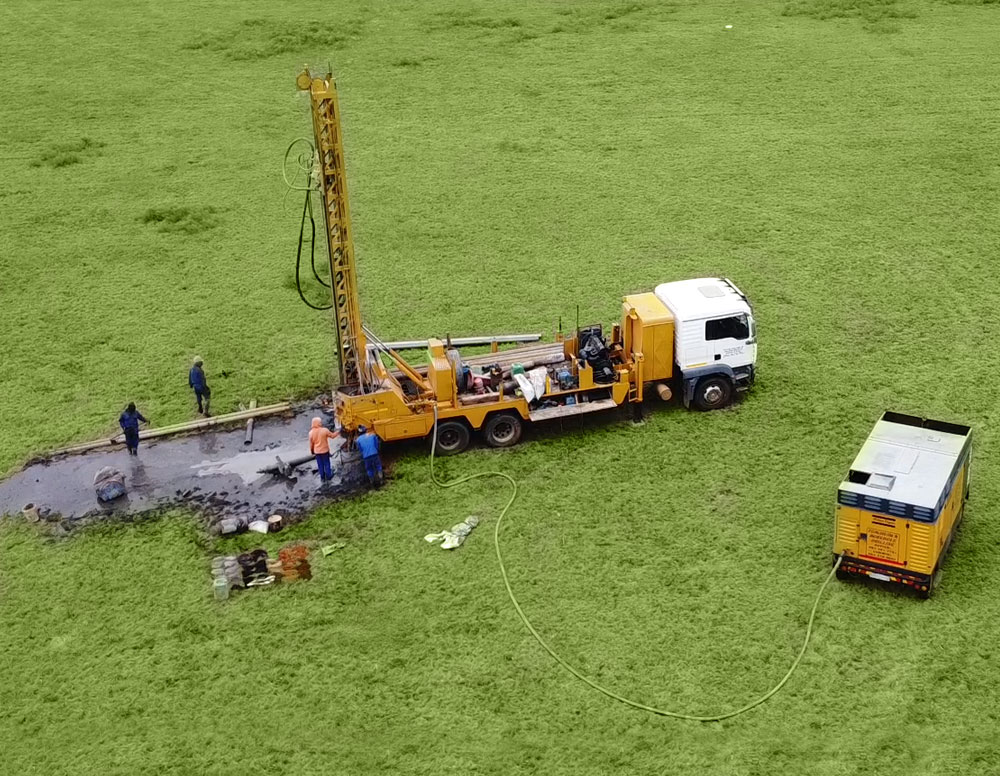
Farm Borehole Drilling in Gauteng and the Vaal Triangle
Tomahawk Borehole Drilling assists farmers, smallholding owners and agricultural businesses with borehole projects across Gauteng and the Vaal Triangle.
Whether you need groundwater for livestock, irrigation or general farm operations, the system should be designed around realistic water demand and the yield available from the completed borehole.
For properties in the Vaal region, see Tomahawk’s borehole drilling in the Vaal Triangle service information.

Plan Your Farm Borehole Around the Water You Need
The best question isn’t simply, “How deep should we drill?”
A better starting point is, “How much water does the farm need, and what system will make the best use of the groundwater available?”
Groundwater surveying, professional drilling, yield testing, correct pump sizing and sufficient storage all contribute to a practical agricultural water supply.
Tomahawk Borehole Drilling can manage these stages for new agricultural borehole installations and existing borehole systems.
Contact Tomahawk Borehole Drilling to discuss farm borehole drilling, agricultural groundwater surveys, yield testing or a complete pump installation in Gauteng or the Vaal Triangle.
More Frequently Asked Questions about Boreholes:
We are also leading borehole drilling company in the following areas:
Borehole drilling in Bryanston
Borehole Drilling in Edenvale
Borehole Drilling in Ferndale
Borehole Drilling in Florida
Borehole Drilling in Fourways
Borehole Drilling in Germiston
Borehole Drilling in Johannesburg
Borehole Drilling in Vanderbijlpark
Borehole Drilling in Parktown
Borehole Drilling in Randburg
Borehole Drilling in Roodepoort
Borehole Drilling in Sandton
Borehole Drilling in Springs
Borehole Drilling in Vereeniging
Borehole Drilling in Vredefort
Borehole Drilling in Woodmead
